


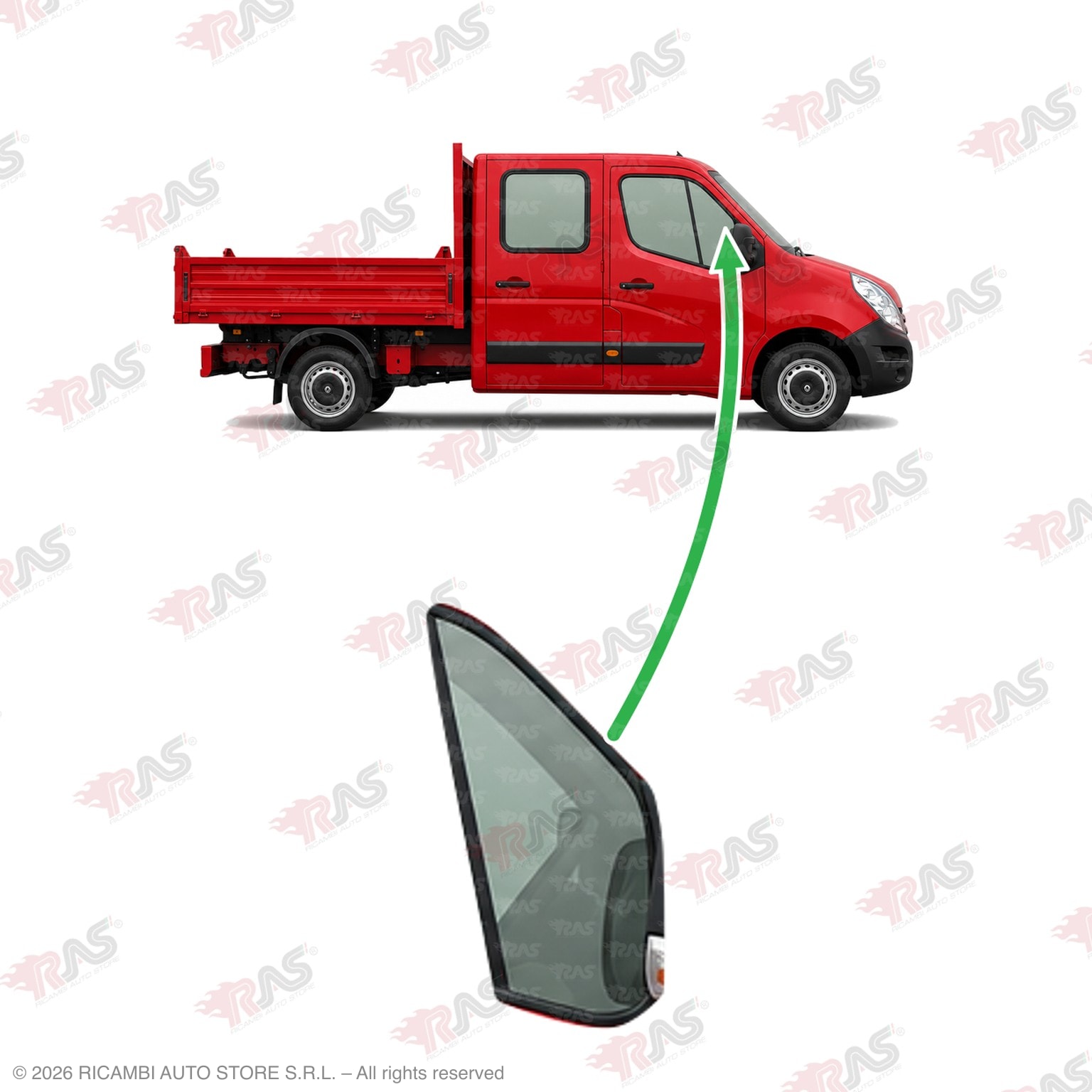
There's a whole world of glass that automotive guides ignore. These are the glasses of vans that work daily, campers where you sleep, and classic vehicles kept alive by those who refuse to give up. They share a common feature that makes them interesting for anyone wanting to work on their vehicle: nearly all are gasket-mounted, allowing for assembly and reassembly without adhesives.
And they have a second characteristic that confuses those coming from the automotive world: in campers and caravans, what we call glass is often not glass at all, but a plastic material that behaves completely differently and needs to be treated with its own rules.
This page brings together the three families, with their logic, problems, and opportunities they offer to those who want to do it themselves.
The glass of commercial vehicles
Vans, work vehicles, and equipped vehicles have glazing that follows a different philosophy from that of cars: it prioritizes ease of intervention and modularity because these vehicles need to minimize downtime.
What changes compared to a car
Installations are more often gasket-mounted. Many side and rear glasses of commercial vehicles are held by a U-gasket with the cord technique, rather than glued. The advantage for those working on them is significant: the assembly is reversible, does not require products with critical times, and a mistake can be corrected by redoing.
The surfaces are larger and flatter. Van glass has less pronounced curves than car glass, simplifying both production and installation and in some cases allowing for custom-made products.
Versions exist with and without glass. The same van model is sold with blind walls, fixed glass, or opening glass, resulting in a practical consequence worth knowing: the side panels can be glazed later by cutting the sheet metal according to the manufacturer's templates and mounting the glass with its gasket. This is common in conversions.
Opening windows are common. Sliding, hinged, or pivoting glasses are found on many work vehicles and are complete assemblies that are replaced as a unit rather than by individual glass.
Glazing is often doubled. Rear doors with two panels have two distinct glasses, which is an advantage: if one breaks, only that one is replaced.
Typical problems
Users of these vehicles are well acquainted with a list of recurring nuisances, almost all related to gaskets rather than the glass:
- Leaks from the perimeters, due to gaskets hardened by sun and age — a problem that means wet goods in a work vehicle.
- Whistles and rustling at high speeds, typical of gaskets that have lost elasticity or non-perfectly seated glass.
- Vibrating glasses in rear doors, where the panels bang over every bump.
- Break-ins, because the cargo area is a target and rear side glass is the most discreet access point.
- Site damage: splashes of mortar, lime, silicone, and paint that require careful removal once hardened on the glass to avoid scratching the surface.
On this last point, an operational tip: cement residues soften with water and are removed with a razor blade held almost parallel to the glass and always wet, never dry and never tilted – it's the same technique described for resin repair finishing in the guide on resin kits.
Camper glass: when glass is not glass
This is the surprise for those coming from cars. In campers and caravans, the driver’s cab has real car glass — windshield, front side windows, typically shared with the van from which the vehicle derives — but all the windows of the living area are almost always made of plastic material.
Polymethyl methacrylate
The material is called polymethyl methacrylate, abbreviated as PMMA, commonly known as acrylic or by the commercial name of a historic version. It isn’t glass and doesn’t behave like glass.
The reasons for this choice are threefold, all crucial in a living vehicle:
Weight. With equal surface area, acrylic weighs about half as much as glass. In a vehicle with dozens of windows and a mass limit to respect, this saving is worth more than any other consideration.
Thermal insulation. Camper windows are composed of two panes separated by a sealed air gap, just like double-pane house windows. The result is significantly better thermal transmittance than a single glass pane, and in a vehicle where you sleep in winter, the difference is noticeable.
Formability. Acrylic can be easily shaped when heated, allowing for complex forms, rounded edges, and direct integration with opening frames.
Behavior and what ruins it
The differences from glass are stark and must be known because almost all damage to camper windows arises from treating them as if they were glass.
- Scratches much more easily. A cloth with a grain of sand, a hard brush, a reused rag: these leave traces on acrylic that would not appear on glass.
- Sensitive to chemicals. Alcohol, ammonia, solvents, and many common glass cleaners permanently cloud the surface, creating a milky appearance that cannot be restored. This is the most common mistake: using regular household glass cleaner and ruining a window.
- Yellows with ultraviolet rays. Intensive and prolonged exposure degrades the material, causing it to lose transparency and take on an amber tone.
- Expands much more than glass. This is why camper window frames are designed with generous clearances: blocking an acrylic panel without expansion room means it will deform or crack with the slightest temperature change.
- Condensation can form in the gap. If the seal between the two panes fails, moisture enters and doesn't leave: it appears as a permanent milky film between the layers. It cannot be repaired and requires panel replacement.
How to clean and maintain them
- Use only plenty of water and mild soap, with a soft, clean cloth. The water helps remove sand before the cloth drags it across the surface.
- Avoid alcohol, ammonia, solvents, or unspecified glass cleaners. Specific products for acrylics exist and are the only sensible choice.
- Never use scrapers or abrasive sponges, under any circumstances.
- Use specific protective treatments that reduce ultraviolet aggression and make the surface more slippery.
- Light scratches: can be minimized with acrylic polishing pastes, acting similarly to polishing glass as described in the guide on scratches and wear on windshields — with the same warning about risking optical distortion if overworked in one spot.
The glass of classic vehicles
Here the main issue is not technical: it's about availability. A glass for a vehicle discontinued thirty years ago or more is no longer in stock, and the question becomes where to find it.
Possible paths
- Reproductions
- For models that had large numbers, there are often dedicated productions, made in limited series for the classic car spare market. This is the best route when available because you get a new piece with the correct features.
- Good condition used glass
- The most common channel. The precautions are those described in the guide on new, equivalent, or used glass, with particular attention to the integrity of the edges: a perimeter chip on a tempered glass is an armed trigger, and on a rare piece, it's a risk worth assessing before installation.
- Custom production
- For flat glass — common on older vehicles — it is a viable route: a tempered or laminated glass can be made from a template. For curved glass, it's much more complex, as a dedicated curvature mold would be needed, making it feasible only for models with enough demand to justify it.
- Gaskets
- Good and often crucial news: gaskets are generally easier to find than glass because they are produced by extrusion and do not require complex molds. Many are available as profiles by the meter, to be cut and joined.
The advantage of classic vehicles
These vehicles have a non-trivial aspect making them simpler than modern ones: installations are almost always gasket-mounted. No structural adhesives, no curing times, no primers with limited shelf lives. The glass is mounted with the cord method, described in the guide on rear window replacement, and dismounted the same way.
Meaning the intervention is completely reversible and within the reach of anyone with patience, a helper, and the right gasket. On a classic car, where every intervention must respect originality, this reversibility is a value in itself.
Specific precautions
- Old rubbers are hard. A fifty-year-old gasket is not elastic: trying to mount glass into it means forcing, and forcing means breaking. Replacing it is almost always obligatory, not optional.
- The channels may be corroded. On a classic vehicle, rust is often found under the gasket: it's the right time to treat it, as the glass is out and the area accessible.
- Flat glass can be cut, tempered cannot. If a vehicle mounts non-tempered glass — possible with the oldest ones — the working possibilities are different. For tempered glass, as always, no processing is allowed after tempering.
- Compliance must be verified. There are specific disciplines for historically significant vehicles concerning preservation of original features: it's a point to clarify with the competent authorities before intervening, especially if considering solutions other than the original.
Glass, Acrylic, and Polycarbonate: Comparison Table
As these vehicles feature different materials, it's worth comparing them: the differences explain why each is chosen where it's applied.
| Characteristic | Tempered Glass | Acrylic (PMMA) | Polycarbonate |
|---|---|---|---|
| Weight per surface area | Reference | About half | About half |
| Scratch resistance | Excellent | Poor | Very poor |
| Impact resistance | Good, but breaks completely | Modest, may crack | Very high |
| Transparency over time | Stable | Good, tends to yellow with UV rays | Yellows sooner if untreated |
| Sensitivity to solvents | None | High: permanent hazing | High |
| Thermal expansion | Low | High: requires clearance in the frame | High |
| Thermal insulation | Modest in single pane | Good in double-pane version | Good in multi-wall versions |
| Workability | None after tempering | Excellent: cuts and shapes when heated | Excellent |
| Typical use | Driver's cab, base vehicle glazing | Living area windows | Impact-resistant applications and shields |
Two useful readings from this table. First: acrylic excels where weight and insulation matter, such as in a camper living area, and loses where surface durability matters, such as in a driver's cab where wipers work. Second: the line on sensitivity to solvents causes the most practical damage because no one expects a glass cleaner to ruin a window.
Gasket-Mounted Installation: Detailed Technique
Since it's the installation common to all three families, it's worth reviewing with tips that make the difference between a successful job and a broken glass.
- Choose the right day. Cold rubber is rigid and uncooperative: with low temperatures, installation becomes a struggle, and the risk of breakage increases. If waiting isn't an option, the gasket must be warmed — in a heated environment, not with a flame.
- Mount the gasket on the glass, not on the bodywork, inserting the glass edge into the corresponding channel along the entire perimeter. Check that it is seated everywhere, with no sections overstepping.
- Insert the cord in the outer channel, the one that will overstep the sheet metal, completing the circuit and leaving the two ends protruding at the bottom, overlapping by a few centimeters. A smooth, strong cord of three or four millimeters is the correct choice: too thin, it cuts the rubber; too thick, it won't fit.
- Lubricate with soapy water or a specific gasket product. Avoid oils or greases: they degrade rubber and eventually cause it to crumble.
- Place the glass from the outside and center it. A helper is needed to support it and apply constant, moderate pressure inward while working.
- Pull the cord from the inside, one end at a time, starting from the bottom and working up the sides until they meet at the top. The angle matters: the pull should be almost parallel to the glass, not perpendicular, otherwise, the rubber won't overstep but rolls.
- Never force. If the gasket won't overstep, the issue is lubrication, temperature, or glass position — not the force applied. Insisting is how glass breaks, and risking a rare piece over a little saved time costs much more.
- Check the lip over the entire perimeter once installation is complete, and adjust points not properly seated with a plastic spatula.
The same technique is described for fixed side windows in the guide on quarter, vent glass, and gasket replacement, equally applicable to a rear window of a classic vehicle, a side glass of a van, and a body-fixed glass.
What These Three Families Have in Common
Juxtaposed, three threads emerge distinguishing them from modern automobiles.
Gasket-mounting dominates. That's why DIY work has space on these vehicles that recent cars don’t have. No structural adhesive means no critical parameters and no irreversible errors.
Surfaces are simpler. Less accentuated curves, more regular geometries, often flat glasses: all conditions making non-standard solutions more feasible.
Electronics are absent or marginal. No ADAS cameras, no optical areas, and on simpler vehicles, not even defrosting. It's the exact opposite of the situation described in the guide on ADAS and recalibration, greatly simplifying all interventions.
For those managing multiple vehicles — a workshop, a business with work vehicles, a rental company — these glasses also have their own procurement logic, involving stock, downtime minimization, and available spares. It's the subject of the content dedicated to professionals and fleets.
Frequently Asked Questions
Can I install windows on a van with blind sides?
It is a common intervention in conversions, and in most cases, the manufacturer anticipates the dual configuration from the design stage, with cutting templates defined on the sheet metal. Three aspects remain to be carefully considered: the correctness of the cut and corrosion treatment of the cut edges, the point where these interventions age badly; the choice of a certified vehicle glass; and verification of vehicle compliance aspects with competent authorities, as body modifications may require interventions.
Can camper windows be replaced with glass?
Technically possible, but almost never advisable. You would lose the two advantages for which acrylic was chosen — halved weight, crucial for mass-limited vehicles, and double glazing insulation — and need to resolve the frame issue, designed to accommodate a panel of that material and thickness, with planned expansion allowances. The normal route is to replace the acrylic panel with an equivalent one.
I used glass cleaner on camper windows and now they're cloudy: can it be fixed?
Chemical hazing of acrylic is irreversible: the material was surface-damaged, not dirtied. In mild cases, polishing with specific acrylic polishes can significantly improve appearance; in cases of deep damage, the panel needs replacement. It's the reason it's crucial to strictly follow the rule: for acrylic, only water, mild soap, and dedicated products.
Are van windows cheaper than car windows?
Often yes, for two reasons: simpler, less curved geometries and many vehicle-compatible versions or even custom-made products. Exceptions are windshields of newer vehicles, which may have features and assistance systems like a car, with corresponding cost and recalibration implications.
How can one find glass for a classic car?
There are four paths: dedicated reproductions, when the model has enough demand; used glass in good condition, carefully checking the edges; custom production, viable for flat glass and complex for curved ones; and registries and clubs for the model, the most reliable source of information on who makes what for that specific vehicle. The starting point is knowing exactly which variant is needed because even classic vehicles had differences between trims and years.
Does a classic car's glass need to be certified?
The applicable requirements depend on the vehicle, its registration date, and the regime it falls under: vehicles of historical interest have specific disciplines considering the need to preserve original characteristics. It's a point to clarify with the competent authorities before intervening, not deduced by analogy with rules applicable to modern vehicles.
Are gaskets for classic vehicles still available?
Generally yes, more so than glass. They are produced by extrusion, a process not requiring complex molds like glass curvature, and many are available as profiles by the meter to cut and join. The joint should be executed carefully, ideally at the bottom and using adhesives compatible with rubber, as this is the entry point for water if done sloppily.
What's the difference between acrylic and polycarbonate?
Both are transparent plastics but with different characteristics. Acrylic is more rigid, more transparent, and more stable under UV; however, it's more impact-fragile. Polycarbonate is much more impact-resistant but scratches more easily and tends to yellow faster if untreated. Camper windows favor acrylic for clarity and stability; polycarbonate is used where impact resistance is crucial.
Do work vehicles suffer more glass damage?
Yes, it's normal: they cover more miles, frequent sites, and gravel roads, and are exposed to aggressive materials. The major difference from private use is that on a work vehicle, downtime weighs as much or more than part cost, which completely alters decision-making logic — from part availability to DIY intervention. This reasoning is explored in content for professionals and fleets.
Is DIY really more feasible on these vehicles?
Yes, and that's why this page exists. A gasket-mounted glass can be dismounted and remounted without adhesives, without critical times, and without irreversible consequences if errors occur: the guiding principle throughout the site — where an error can be corrected, DIY is sensible — finds its clearest application here. Usual precautions remain: two people, appropriate suction cups, new gasket, mild temperatures, and no haste.
Do camper roof hatches follow the same rules as windows?
Yes, with some added complications. They're also made of plastic, generally acrylic or polycarbonate, and suffer the same enemies — solvents, abrasives, UV rays — but with much greater sun exposure due to horizontal placement. Add hail, against which a plastic dome is more vulnerable than glass, and low branches, common culprits of damage when accessing pitches. Hatches also have unique gaskets and opening systems, where infiltrations occur more than on panels.
How do I protect the glass of a vehicle left unused for months?
Typical for campers and seasonal vehicles, with few useful precautions. Cover with breathable covers, never with direct-contact plastic, which traps moisture and marks surfaces. Clean before storage, as resin, droppings, and mineral deposits left for months chemically attack both glass and especially acrylic. Raise wipers or use separators to prevent permanent deformation from pressing in the same spot. And air out the interior periodically to prevent stagnant humidity from fostering mold and odors.
Should a spare glass be kept for a commercial vehicle?
For those using the vehicle for work, the answer is often yes, and the logic is about downtime. A side or fixed rear van glass is relatively inexpensive, occupies little space if stored vertically and properly protected, and turns a days-long wait into an afternoon job. This doesn't apply to windshields and rear windows, which are bulky, expensive, and delicate to store. This is fleet management reasoning, developed in content for professionals.
Why does my van's windshield cost as much as a car's?
Because recent commercial vehicles often have windshields with the same features as a car: cameras for assistance systems, rain sensors, wiper zone heating, and sometimes acoustic film. Vehicle safety regulations have gradually extended various functions to work vehicles too, meaning replacement entails recalibration just like a car. Add this to large surfaces and smaller production volumes. The price components are the same described in the guide on the cost of windshield replacement.
Are the openable windows of vans repaired or replaced?
Depends on what is broken. If the issue is the glass, many systems allow a single glass replacement within the existing frame. If the issue is with the mechanism — like the sliding guide, handle, or safety catch — it's often addressed without touching the glass. The worst case is frame deformation after an impact, as alignment and glide can't be restored with adjustments, making replacement advisable. Before ordering, it's worth determining which of the three situations applies: they're different parts with very different costs.